

Jyoti Maheshwari
CAMS, ACA
Money laundering (ML) is typically a transnational crime. This means that persons who commit crimes such as money laundering are more often than not located in different parts of the world.
This is why it is important for countries to come together to fight the risks of money laundering. There are various international organisations working toward this goal.
Here’s a list of the top organisations combatting the risks of money laundering.
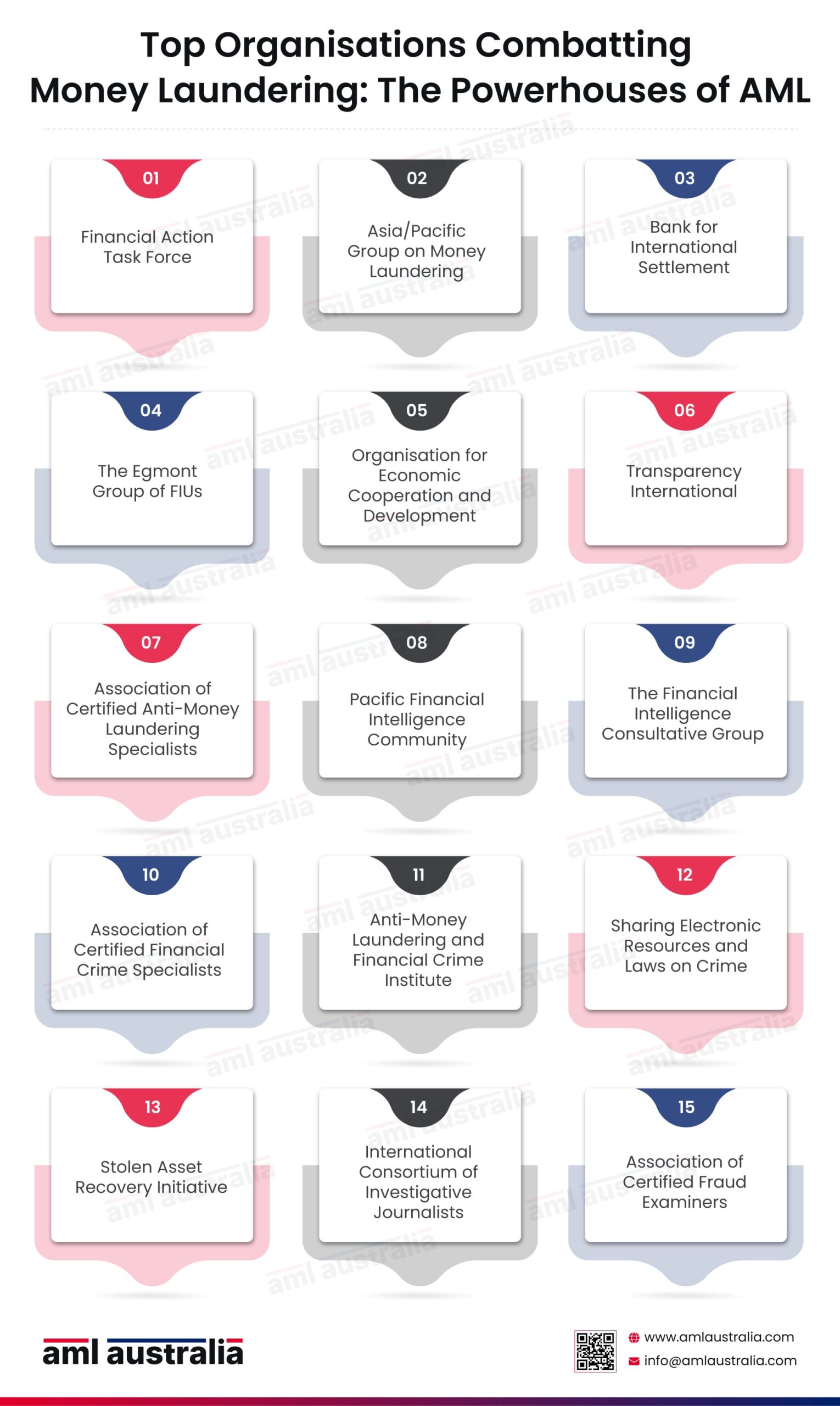
Top Organisations Combatting Money Laundering
Financial Action Task Force (FATF)
FATF is an intergovernmental organisation. It sets international standards for combatting money laundering, terrorist financing, and proliferation financing (ML, TF, and PF).
The FATF has published 40 recommendations and 11 immediate outcomes for implementing its standards. It is done by conducting a mutual evaluation of the country’s Anti-Money Laundering (AML) efforts.
Australia is a founding member and an active member of the FATF.
Asia/Pacific Group (AGP) on Money Laundering
While FATF provides an overview of the global money laundering trends, the AGP on Money Laundering is a regional FATF-style body that facilitates regional cooperation between its member nations through technical assistance, training, mutual evaluation and active engagement in the global AML/CFT policy development.
Australia serves as the permanent co-chair of the AGP on Money Laundering with the AGP secretariat formally established in Sydney.
Bank for International Settlement (BIS)
The Basel Committee on Banking Supervision at BIS is an important organisation setting regulatory standards for central banks worldwide, including the Reserve Bank of Australia and the Australian Prudential Regulation Authority.
The guidance issued by the Basel Committee on “sound management of risks related to money laundering and financing of terrorism” gives financial institutions insights on how to improve their AML compliance measures in line with the FATF recommendations.
The Egmont Group of Financial Intelligence Units (FIUs)
The Egmont Group is a common forum for FIUs from 177 countries and observers for exchanging financial intelligence and international cooperation to counter the risks of ML, TF, PF, and their predicate offences.
The Australian Transaction Reports and Analysis Centre (AUSTRAC) is a founding member of the Egmont Group.
Organisation for Economic Cooperation and Development (OECD)
OECD, for its member countries, works with policymakers and other stakeholders to make policies for tackling common environmental, economic and social issues faced by its member countries.
Fighting financial crimes, such as money laundering and terrorist financing, is one of the focus areas in which the OECD works.
Australia is a member nation of the OECD.
Transparency International
Transparency International primarily works against corruption. The Australia chapter of Transparency International works to prevent illegal money from entering the country’s financial system.
It works to close the gap in Australia’s AML regulations that leave out the scope for illegal activities.
Association of Certified Anti-Money Laundering Specialists (ACAMS)
ACAMS offers professional certifications and also hosts international conferences which focus on Anti-Money Laundering (AML) compliance and their regulatory frameworks.
Individuals who want to build a career in AML compliance can improve their credentials by getting a Certified Anti-Money Laundering Specialist (CAMS) qualification.
Pacific Financial Intelligence Community (PFIC)
The Pacific Financial Intelligence Community (PFIC) is a platform for 15 Pacific FIUs. Member nations of the PFIC can collaborate on subjects like operational capabilities, research results, tech-sharing and capacity building.
The PFIC meets virtually and in person every two months on an annual basis. These meetings are co-chaired by AUSTRAC and Papua New Guinea’s FIU- Financial Analysis and Supervision Unit (FASU).
The Financial Intelligence Consultative Group (FICG)
FICG is a regional forum for FIUs from Australia, New Zealand, and Southeast Asia. The purpose of FICG is to promote, enhance, and strengthen AML/CFT collaboration for its members.
AUSTRAC is the permanent co-chair for FICG. Other partner country’s FIUs assume chairmanship position on a rotating basis.
Association of Certified Financial Crime Specialists (CFCS)
CFCS offers many solutions around training, membership, and professional certifications to combat financial crimes. More than 80 countries consider these certifications and training as a benchmark of excellence.
Anti-Money Laundering and Financial Crime (AMLFC) Institute
The AMLFC institute conducts partnerships with universities and professional organisations to counter financial crimes. It provides a range of certifications for AML, counter-terrorism financing, cybersecurity, fintech, and other regulations related to these subjects.
The institute also supports research programs which seek to improve AML practices and AML compliance frameworks.
Sharing Electronic Resources and Laws on Crime (SHERLOC)
Australia is a party to the United Nations Convention against Transnational Organized Crime (UNTOC). To support the effective implementation of UNTOC and its three supplementary Protocols, the United Nations Office on Drugs and Crime (UNODC) developed SHERLOC.
SHERLOC is a public platform that facilitates the dissemination of information regarding the implementation of UNTOC and the international legal framework against terrorism. It offers a comprehensive collection of legal resources and information related to organized crime from all 193 UN Member States, as well as non-member observer states, the European Union, and other parties to the Convention.
Stolen Asset Recovery Initiative (StAR)
StAR is funded jointly by the United Nations and the World Bank.
It assists victims of fraud and other financial crimes in recovering their stolen assets. It also helps countries fight corruption and increase accountability.
International Consortium of Investigative Journalists (ICIJ)
ICIJ has a global network of investigative journalists in more than a hundred countries. ICIJ is known for its investigation into many high-profile financial crimes like the Panama Papers scam.
Association of Certified Fraud Examiners (ACFE)
ACFE gives Certified Fraud Examiners (CFEs) credentials to people who want to build a career in fighting financial fraud. It also trains them and gives them many online resources like courses, statistical data, case studies, etc.
Top Organisations Combatting Money Laundering: In Summary
It is important for countries to work together to fight financial crimes. These international organisations give governments a platform and opportunity to collaborate.